Pearson Edexcel · A-Level · Economics B
Course version: 9EB0 · Version from Sept 2015
B) Calculate marginal cost and marginal revenue
Full specification wording
Business objectives and pricing decisions: b) Calculate marginal cost and marginal revenue
Marginal cost (MC) and marginal revenue (MR) measure the impact of producing and selling one additional unit of output.
Checked against the Pearson Edexcel 9EB0 specification (opens in a new tab) on .
- Point 2 of 3
- 3 key terms
Study notes
From the checked teaching notes for this specification point.
The idea
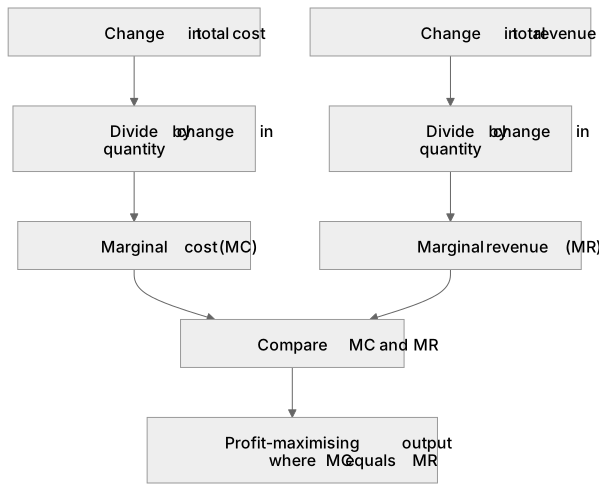
Marginal cost (MC) and marginal revenue (MR) measure the impact of producing and selling one additional unit of output. Marginal cost is the change in total cost divided by the change in quantity (MC = ΔTC / ΔQ). For instance, if total cost rises from £500 to £520 when output increases from 100 to 101 units, the MC is £20. Marginal revenue is the change in total revenue divided by the change in quantity (MR = ΔTR / ΔQ). If total revenue increases from £800 to £815 when selling that 101st unit, the MR is £15. Firms use these calculations to find the profit-maximising level of output, which occurs where MC equals MR. If MR exceeds MC, producing the extra unit adds to total profit, guiding crucial business pricing decisions.
What earns the marks
- Marginal cost is calculated as the change in total cost divided by the change in quantity.
- Marginal revenue is calculated as the change in total revenue divided by the change in quantity.
- Marginal cost only includes variable costs, as fixed costs do not change with an additional unit of output.
- The profit-maximising level of output is identified at the point where marginal cost equals marginal revenue.
Common mistakes and how to put them right
Dividing total cost by total quantity to find marginal cost.
Put it right: This calculates average cost, whereas marginal cost requires dividing the change in total cost by the change in quantity.
Assuming marginal revenue is always constant.
Put it right: For a firm with downward-sloping demand, marginal revenue falls as output increases and is lower than average revenue.
Confusing marginal cost with variable cost.
Put it right: Marginal cost is the cost of the next specific unit, not the total or average of all variable costs.
Exam tips
- When calculating marginal values from a table, look at the difference between the current row and the previous row for both total value and quantity.
- Pay close attention to the change in quantity; if output increases by 10 units rather than 1, you must divide the change in total cost by 10 to find the marginal cost.
- Remember that profit is maximised when marginal revenue equals marginal cost, which is a frequent target for multiple-choice questions on business objectives.
Try the lesson
The start of the Business objectives and pricing decisions: b) Calculate marginal cost and marginal revenue lesson, made from checked teaching notes for this specification point.
Have a go first
A manufacturing firm increases its output from 100 units to 101 units. As a result, its total costs increase from £500 to £515. What is the marginal cost of the 101st unit?
Listen
Marginal cost (MC) and marginal revenue (MR) measure the impact of producing and selling one additional unit of output. Marginal cost is the change in total cost divided by the change in quantity (MC = ΔTC / ΔQ). For instance, if total cost rises from £500 to £520 when output increases from 100 to 101 units, the MC is £20. Marginal revenue is the change in total revenue divided by the change in quantity (MR = ΔTR / ΔQ). If total revenue increases from £800 to £815 when selling that 101st unit, the MR is £15. Firms use these calculations to find the profit-maximising level of output, which occurs where MC equals MR. If MR exceeds MC, producing the extra unit adds to total profit, guiding crucial business pricing decisions. A strong answer earns marks for these points. Marginal cost is calculated as the change in total cost divided by the change in quantity. Marginal revenue is calculated as the change in total revenue divided by the change in quantity. Marginal cost only includes variable costs, as fixed costs do not change with an additional unit of output. The profit-maximising level of output is identified at the point where marginal cost equals marginal revenue. Exam tip: When calculating marginal values from a table, look at the difference between the current row and the previous row for both total value and quantity.
See it
Key words
Say what each word means before you turn the card.
Marginal cost
Try answering aloud or in your head before turning the card.
Marginal revenue
Try answering aloud or in your head before turning the card.
Profit-maximising level of output
Try answering aloud or in your head before turning the card.
See every definition
- Marginal cost
- The change in total cost divided by the change in quantity, measuring the impact of producing one additional unit of output.
- Marginal revenue
- The change in total revenue divided by the change in quantity, measuring the impact of selling one additional unit of output.
- Profit-maximising level of output
- The level of output that occurs where marginal cost equals marginal revenue.
There is more to this lesson
The full lesson goes on to check your understanding and help you earn the marks. Create a free account to carry on, with your progress saved.
A week of Premium from your first lesson · Then the free plan continues · No card, no charge
Test your understanding of Business objectives and pricing decisions: b) Calculate marginal cost and marginal revenue
Active recall beats re-reading. Take an instant quiz now to test what you’ve learned and lock it into long-term memory.
A week of Premium from your first lesson · Then the free plan continues · No card, no charge